Showing posts with label Music. Show all posts

Saturday, April 12, 2008

Gimme Some Skin

I am currently working on AIDA for San Diego Opera - no, I was not cast as Radames (or Amneris) but am instead serving as body-makeup artist. What does this job entail, you ask?

Well, I must arrive at the opera two hours before curtain time and venture into the lower depths of the theatre where I (and several other makeup folk) get to spend three hours applying body makeup to various supers, dancers, and some of the chorus.

The vast majority are men ranging in looks from stunningly beautiful to elderly teamster. For about two and a half hours these assorted men wander over to the body makeup area in their opera-supplied skin-pink underwear and I ask them if they are Egyptian or Ethiopian. Depending on their answer they are made up with either Light Egyptian or Dark Egyptian body makeup.

They are escorted over to an empty spot on the plastic-covered floor and I spray them down with a water bottle. This makes the makeup flow better, quicker, and more evenly. Using small round sponges and pancake make-up of the chosen shade, I proceed to daub, wipe, pat and otherwise apply the makeup to pretty much every exposed inch of them save their heads, hands, and feet -- which are their own responsibility.

We are basically just trying to apply an even, smooth color. There is not much time for subtlety. I have worked up a few tricks and quick-and-easy frills to this crank-em-out process. I try to make sure the body makeup fades realistically into their necks and faces which are sometimes too light or too dark. I also usually apply a quick dappled sponge effect to darken the tops of their shoulders, like natural sun exposure creates. And a last little trick of mine, when doing their backs, is to start with a very dark spongeful of makeup down their back bones. This makes a little valley of makeup which can then be feathered out with the sponge. It not only avoids streaks but also adds a subtle hint of muscle definition to their backs.

Other elements of the job include hiding tattoos, doing a body makeup quick-change on eight dancing girls in about eight minutes, and then a lot of clean up afterwards: washing sponges, refilling water bottles, preparing for the next performance, etc.

It's kinda funny having a job where a man in his mid 20s comes up to you in his underwear and apologizes for not shaving his armpits better.

This Light Egyptian makeup has an interesting backstory. It was developed by Max Factor for Lena Horne who desperately wanted to play Julie in the 1951 remake of SHOWBOAT. The studio apparently worried that Horne was "too light" and Max designed Light Egyptian to darken Lena Horne's skin to an appropriate shade for the studio. Then as Ms. Horne has told it, "They went and hired my good friend Ava Gardner to play Julie and covered HER in MY Light Egyptian!"

So in a few hours I must head to the theatre for my opera chores. SOMEBODY has to do it!

Aida, Aida, I just met a girl named Aida . . . that's a different show, isn't it?

--David

Wednesday, January 2, 2008

Slashing Sweeney Todd


Well, the web seems inundated with reviews of Tim Burton's film version of Sweeney Todd, some smart, many stupid. A friend in NYC said a bunch of goth kids came into the bookstore where he works and they'd just seen Sweeney. When they heard that the original Mrs. Lovett was created by Angela Lansbury the darling goth tykes responded, "Eeeww! That dumpy old woman! Was she the best they could get?"

Kinda makes a fella wanna move to France. . .

The original Stephen Sondheim Sweeney Todd opened in 1979 and it was my very first Broadway show. I got my chance to see it on a family trip to NYC when I was sixteen. It was only a couple months after Sweeney had opened and it still had the original cast of Len Cariou, Angela Lansbury, and Victor Garber. It really was extraordinary.

I have seen most of the important Sweeneys since: the New York City Opera version circa 1987 with Timothy Nolen and Joyce Castle, the 1989 Circle in the Square Broadway revival with Bob Gunton and Beth Fowler, the 2005 Broadway revival with Michael Cerveris and Patti Lupone. And the video version of the Lupone/Hearn SWEENEY concert, and of course the Lansbury/Hearn video. Heck, I've even seen the old black and white non-musical British film The Demon Barber of Fleet Street (1936), starring the amusingly named Tod Slaughter. I also designed a large-scale production of Sweeney for Skylight Opera in Milwaukee in 1997. Click Here for Pics and Blog.

Ok, now that my throat-slitting creds are established ...

I saw Burton's Sweeney on opening day and found it very enjoyable for the most part. I think it is probably Burton's best film since Ed Wood. I really wanted to like it and at the time I managed to convince myself that I did. I thought it looked really good. The smog-choked London of the 1840s was made quite real. Johnny Depp is certainly the right age and has the intensity to play Sweeney well, as does Helena Boham Carter to play Mrs. Lovett.

Burton has heavily cut the score for some unfathomable reason. At first I thought it was due to length, but on checking running times I found Burton's film runs about fifteen minutes LONGER than the full-length stage version does. Perhaps Burton truly wasn't up to directing a musical. I understand the reason for cutting the "Attend the Tale of Sweeney Todd" chorus parts. They are a theatrical conceit, and a stronger opening could be created for the film without it. But omitting the Act I quartet is bizarre. It's crucial to the development of the score. And paring down "A Little Priest" makes it seem like Burton simply didn't know what to do with the song. Or perhaps Depp and Bonham Carter simply weren't putting it over.

Spoiler Warning!

In the film Depp's and Bonham Carter's voices seemed fine. But as I've listened to the soundtrack since, they both sound very tentative and like they are at an early read-thru of the score. There is just not enough character in their singing, especially Bonham Carter's. In her opening number, "The Worst Pies in London," she should be chewing the hell out of the song - yet it has so little energy, it is so flat. Somehow Burton has stripped all of the comedy from the song. It needs to be lived and felt and made spontaneous. Mrs. Lovett is a very poor woman trying to get by selling meat-pies. She is supposed to be delighted that Todd--"A customer!!"
--has just walked in the door. Instead, Bonham Carter gives us a Mrs. Lovett that is so underplayed it becomes confusing. On the one hand she should be trying to make a schilling by selling Todd a pie and on the other she wants empathy as she admits her pies are disgusting and gross. This slightly schizophrenic point-of-view is essential to Mrs. Lovett's character. It is what enables her to rationalize her way into serving cadavers as entrées. This multi-dimensional quality is largely missing from Bonham Carter's performance. And to top it off, the lyrics are simply hard to hear and understand.

Alan Rickman makes a wonderful Judge Turpin. Indeed, he would have made a great Sweeney. Sascha Baron Cohen (and his manhood) ably play Adolpho Pirelli. Though again a comedic moment goes for naught when Cohen switches from his over-the-top Italian accent to his Irish accent. Why is nothing funny in this movie? Jamie Campbell Bower sings beautifully as Anthony the young sailor, but he looks so pretty and girlish that it's hard to believe he serves any purpose on a ship other than butt-boy to all the "real" sailors, and it seems more likely Johanna should be rescuing him.

Burton made an interesting choice in the casting Ed Sanders as Tobias Ragg. Toby is most often played as a rather dim-witted young man/teenager. Burton cast a little kid who comes across as about eight years old. He has a lovely voice and makes "Nothing's gonna harm you" sound really wonderful. This is no reflection on Sanders abilities, but a kid that age simply can't act well enough to carry his weight in the drama. An genuinely little child has no real chance of "protecting" Mrs. Lovett from harm; and in the final scene when Toby is exposed to the horrors of the bake-house and meat grinder we need to hear a cry of terror and pain that makes our blood grow cold. Young Mr. Sanders just yells, "Mrs. Lovett, let me out," like maybe he has to go to the bathroom really bad.

You may have guessed that I am not a big Tim Burton fan. I think he has a wonderful imagination and a strong personal style, but I have always felt he needed to be more tightly reigned in, that his ideas were too often brilliant first drafts that were never refined enough or thought through, that often his ideas were simply there because they were "cool" and if they made hash of the story-telling or characterizations, it seems Burton thinks, "Who cares, it's cool"! Here are a few of the most disturbing "Burtonisms" in the film:

The Opening Credits
It seems hard to believe that Burton will blow his wad in the opening credits by showing the audience the barber chair, the chute, and the meat grinder full of body parts. A good story teller would make the audience wait and build up the suspense. Why enact the plot in mediocre CGI animation before the film has even started?

The Tower Bridge
Moments into the film Sweeney goes sailing down the Thames under the Tower Bridge. The film appears to be set circa 1840, but the Tower Bridge wasn't built until 1894, some fifty plus years after the film takes place. Whether this was Burton's idea, or Production Designer Dante Ferretti's, it was a stupid mistake and makes both men look unprofessional. I have seen several other blogs online talking about this goof and a number of people seem to argue back: "But it's a musical! Since when does a musical have to be accurate? People don't sing in the streets either!!"

Well, that's not the point. It's bad because I wanted to be paying attention to the story and music and not be jarred out of my seat by architectural anachronisms. I don't want to see the Eiffel Tower on a backdrop for Les Miz either! Science Fiction films don't HAVE to be historically accurate, but if Peter Jackson had put the World Trade Center in his 1933 period-correct KING KONG because he thought it looked cool - well, it would have been stupid!

Passing Sentence and Key-hole peeking
To show the quality of Judge Turpin's character there is a scene where the Judge passes a sentence to "Hang by the neck until you are dead" on some poor prisoner in the dock who has committed a petty crime. In the show it's a young man and the severity of the sentence to the crime is considered sufficient to show the Judge's character. Burton ends the scene by pulling back to show the condemned prisoner is a little kid, possibly six years old, weeping hysterically. Ahh, subtlety.... In another scene the Judge watches Johanna through a secret peek-hole. It's in the original show, it's creepy, and helps define character. Yet for some odd reason Burton explicitly has Judge Turpin watch Johanna sitting in her window, engaging with the sailor and throwing a key to him. Yet later on when Judge Turpin hears Johanna has made these plans he seems to have no idea he watched it all himself earlier that day. The scene could have been solved by having the Judge simply quit peeking before Johanna throws the key. Go figure.

Little Bald Boys
Casting little kid Ed Sanders as Toby seems like a good idea when he's singing. But his big solo number is about his job selling a hair growing tonic and how he went from being completely bald to having a full head of hair. Hmmm .... I don't know many bald little boys, do you? It makes no sense.

The Meat Grinder
Mrs. Lovett's meat grinder is so over the top it seems ridiculous. It stands about seven feet high with an opening many feet across. Why? Where did she get a several ton cast-iron meat grinder? Huh? Also, Burton as usual must throw subtlety to the winds. In the show Toby finds some hair and then a fingernail in a meat pie, he puts two and two together, and figures out what's going on in the horrific bakehouse. In Burton's scene Toby finds a whole finger. It's just crass and doesn't allow the audience to make the journey and see the horror grow as Toby figures it out.

End Credit Music
The film ends with a bloody tableaux of Sweeney holding Lucy, both dead and bloody. Then the credits roll and we get an unimaginative jumble of music from the film. This would have been such a perfect place to hear "Attend the Tale of Sweeney Todd." At the end of the credits Depp and Bonham Carter could even have risen from the dead, like they do in the show, for a post credit "Gotcha!"

It isn't a bad film. I will certainly buy the DVD. But it could have been so much better. Burton doesn't seem to understand that the comedic moments are there to let the audience catch their breath, to relax the audience, so he can scare them all over again. Sweeney needed to be a roller coaster ride of giggly gruesome humor and stark terror. Burton's Sweeney is very one-note. Burton has put his imagination into everything from the little bald boy to the six-ton meat grinder. It's in the CGI smog-filled London and the cockroaches in the pie shop. It's in the squirting blood and in the whole finger that Toby finds in his pie.

But here, perhaps, is the rub ... Burton's vision is so "imaginative" that nothing is left to the audience's imagination, and it's a shame Burton doesn't understand that that's where true horror lies.

Copyright © 2008 D. H. Maxine

Thursday, December 13, 2007

Dancing Naked with PUFNSTUF


In 1971, when I was eight years old, I was taken to see the then new PUFNSTUF movie. I already loved the psychedelic television show of the same name. But the movie appealed to me for many reasons. I wanted to escape, I thought Jack Wild was cute, it was a movie musical that resonated of many things I loved including a similarity to the plot of THE WIZARD OF OZ. I adored Jack Wild's peculiar British accent, and now as an adult, I can see other reasons that the film spoke to me.

For those of you too young, too old, or too foreign to know the film, the story goes thusly:

A boy named Jimmy is picked on by his classmates and teachers. Jimmy plays the flute and one day his flute comes to life and starts to talk. A nasty old witch named Witchiepoo wants Jimmy's talking flute for herself and she tricks Jimmy into boarding a beautiful boat which traps him and brings him to Living Island. Jimmy escapes the witch's clutches and befriends a yellow dragon named Pufnstuf who wore little white cowboy boots and a Stetson. Jimmy wants to get back home, protect his flute from Witchiepoo, and in the end finds peace and love with his friends on Living Island.

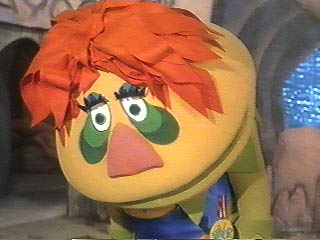
There's an interesting Freudian interpretation of the film that I've heard about. Our boy hero Jimmy is about to enter puberty and his "flute" which had been inanimate suddenly comes to life. Witchiepoo (the mother figure) wants to take away Jimmy's "magic flute." For protection, Jimmy seeks out an even bigger phallic symbol, Pufnstuf himself. I wonder what PUFNSTUF creators Sid and Marty Krofft think of this interpretation. Pufnstuf himself does look pretty phallic. Look at his "head" in the photo at the top of this blog.

Okay, back to being eight years old... Well, I loved the movie and I loved my copy of the soundtrack album. I played it to pieces, played it for my friends, and being a little gay boy I had as big a fascination with Witchiepoo as I did with Jimmy.


Soundtrack album cover for PUFNSTUF (1970)

In the movie Witchiepoo hosts the Annual Witch's Convention in her castle. Witches are quite "political" it seems; and there is a power struggle to obtain the title of "Boss Witch." The current Boss Witch was played by Martha Raye; and other contenders for the title included Witchiepoo, and another witch named Witch Hazel who was played by Mama Cass Elliot. Witch Hazel sang a song called "Different."

"When I was smaller and people were taller
I realized that I was different.


It's kind of an ode to being gay (from a little gay kid's point of view anyway). It's not unlike Cass Elliot's big hit "Make your own kind of music." On the soundtrack album, this song is followed by a spectacular production number called "Zap the World!" which is what the witches want to do. I lapped it all up!

My best friend at the time lived next door. One summer afternoon while we were playing my PUFNSTUF album we decided to make "magic wands." In the movie the magic wands look kind of like striped pencils. And indeed that's what we made. We took some unsharpened pencils and carefully wound them with colored tape making spirals about the pencils. We also made them "magic" by putting spells on them and saying magic words and stuff. At some point my best friend said, "You know if we want to make them really magic, we're supposed to be naked."

"What are we supposed to do then?" I asked in my best naïvely coy eight-year-old manner.

My friend said, "We have to dance with them."

It sounded like a good idea to me! So we locked my bedroom door. We put on the PUFNSTUF album, and played "Different" as an invocation while we got undressed. When we were both naked we stood on my twin bed and waited for "Zap the World!" to begin. At which point the eight-year-old, wand-waving, naked, wannabe-witches began dancing excitedly, jumping up and down on the bed!

So what do you do when the music stops?

Well, you put on your clothes, you put the magic away, and you grow-up. You try to make friends with other people, hoping for a friendship like Jimmy's and Pufntuf's. And you long to find a Living Island where you attempt to avoid the witches, where you can play your magic-flute, and when the planet gets too obnoxious, you can …

Zap! Zap the World!

David

Blog copyright © 2007 D. H. Maxine.


Below, you can enjoy "Zap the World!" from PUFNSTUF the movie!


Monday, December 10, 2007

TURANDOT

Final Design Painting TURANDOT - Act II, Scene 2

A number of you have asked me about my days as a Set Designer and so I thought I'd post a few things.

For my thesis at Yale, where I was getting my MFA, I chose to design Giacomo Puccini's opera TURANDOT. Some of my fellow students thought I was a bit fool-hardy to choose an opera set in China when the head of the design department was the highly respected Chinese/American Set Designer, Ming Cho Lee. Luckily he was pleased with my design and I got my MFA. Oh, I did get into trouble on ONE little thing. The Emperor's hat (in the costume sketch) is from the wrong period based on most of my architecture. I told Ming I'd change the hat.

Below are presented various steps in the design process. The "thesis" design had to include paintings, a 1/4" scale model, full architectural drafting, lighting sketches, and costume designs. We also had to design the set as if for a "real" opera house - so I chose the MET. I also used this project for my "union exam."

Below you will see the initial watercolor sketch for each set followed by a photograph of the 1/4" scale model. For reference a person is only one and a half inches tall.

I began months before by absorbing every note of TURANDOT via CD. I also read everything about the opera that I could. I wanted simple and elegant - not over-the-top Zefferelli. I chose a red-lacquer motif for almost everything. I started out doing quick paintings of the big moment in each act.


First watercolor sketch TURANDOT - Act I


1/4" scale model of TURANDOT - Act I

Act II - scene 1 "Ping, Pang, Pong" trio
For the opening of Act II I wanted the "Ping, Pang, Pong," scene to be intimate and small. It's a lovely little lyrical scene and it contrasts wonderfully with the huge spectacle of the "In Questa Regia," and "Riddle" scenes of Act II - Scene 2. I set the little scene in a small red-lacquered room - just the size for the three-person scene.


First watercolor sketch TURANDOT - Act II, Scene 1

Act II - scene 2 "In Questa Reggia," and "Riddle" scene.
As the first scene ended the little red room appeared to slowly shrink into blackness and just as it completely disappeared it reopened with the the big fanfare of scene 2 revealing the great staircase, emperor, et al.


1/4" scale model of TURANDOT - Act II, Scene 2

Act III - scene 1 "Nessun Dorma" and "Death of Liu" scenes.
A fairly barren scene with the unknown Prince out in the Gardens while he is cajoled, bribed, and threatened into revealing his name. I also like his appearing small and lonely and a little vulnerable among the giant statuary. Often the chorus would enter from upstage as if the garden was at the top of a terrace.


First watercolor sketch TURANDOT - Act III, Scene 1


1/4" scale model of TURANDOT - Act III, Scene 1

Act III- scene 2 "Turandot Guesses Correctly" scene.
We revert to the Act II - Scene 2 set. As imaginary director I also opted to use the full-length Franco Alfano ending. It's wonderful AND it gives me another forty seconds of set change music.

Down below are my costume sketches of the main characters. As a set designer I was not required to go beyond the "sketch" stage for this project.

I hope you've enjoyed this glimpse into David's designing days. Iif the MET calls, I'm their boy! Actually, if ANYBODY calls I'm their boy! If you have any questions about the project, please feel free to ask in the comments section and I'll try to oblige. Thanks for looking.

David

All images, photos, and designs copyright © 2007 by David Maxine. All rights reserved.

Saturday, December 8, 2007

RING around the Russians


DIE WALKURE - Act III

STUPENDOUS BUT STUPID

Well, I'm back from the end of the world, and my fifth live RING cycle was a mixed bag. No production of Richard Wagner's fifteen-hour-long epic DER RING DES NIBELUNGEN is ever perfect. But alas, the highs and lows of the inane and confusing production-concept somewhat marred the often spectacular music.

Conductor Valery Gergiev and the Kirov Orchestra produced a RING of unusual beauty. The orchestra was perhaps the clearest and most transparent version of the RING I have ever heard. Gergiev had the ability to make Wagner's massive orchestra often sound like chamber music. This is meant as a compliment. One could hear each orchestral voice blending into a Wagnerian tapestry with each individual thread of orchestral color, intermingling to make a lovely sound-picture.

I did find Gergiev's conducting of RHEINGOLD to be a little lifeless and the horns had a rough time. A friend at the opera suspected it was the dry California air taking its toll on the Russian horn players. But the horns solved their problems sometime during DIE WALKURE and Gergiev came to life for the final three operas.


SIEGFRIED - Act III
Siegfried meets the Wanderer


The singing in RHEINGOLD was solid. There were no weak links; but most of the cast didn't bowl me over, although the Alberic of Edem Umerov and the Mime of Nikolai Gassiev deserve special mention.
The Erda had a thick Russian accent. I do not speak German, but even I could hear it. Her RHEINGOLD aria began as something like, "Vikeeee, Votann, Vikeeee!" In WALKURE, Placido Domingo joined the all-Russian cast to sing Siegmund. He was astounding with beautiful tone, a strong ringing voice. Hard to believe he is sixty-five. The WALKURE's Fricka (Larissa Diadkova) was lovely and empathetic and made one almost side with her against Wotan sung by Mikhail Kit. Oddly though, Fricka left the stage before singing her final lines to Brunnhilde in Act II. The super-title came up, but Fricka was long gone. As might be expected the Kirov choral work was spectacular. The Valkyries sang with a clarity I have never heard before, as did the Gibichung Vassals in GOTTERDAMMERUNG.

But the star of the Kirov RING was the Brunnhilde of Olga Sergeyeva. She has a lovely voice (with a trill no less!) and she had no trouble cutting through the Wagnerian orchestra. Her "Battle Cry" was perhaps her weakest moment, but from there on she took command and sang a spectacular WALKURE Act III, a luscious and orgasmic final duet in SIEGFRIED, and the best GOTTERDAMMERUNG Brunnhilde I've ever heard, capped by an "Immolation Scene" that burnt the house down. If her voice weren't enough, La Sergeyeva is a Wagnerian triple-threat. In addition to her voice, she is lovely, appears to be young, and has a stunning figure. And she can act! Thus Sergeyeva's triple-threat status makes her the finest Brunnhilde singing today, IMHO.

We got two different Siegfrieds; one each for SIEGFRIED and GOTTERDAMMERUNG. The SIEGFRIED Siegfried was Leonid Zakhozhaev. He was spectacular. He was thin, youthful, sexy, and could easily pass for twenty onstage. So he certainly looked like Siegfried. So what is our surprise when he opens his mouth and even sounds like Siegfried! He has a bright ringing voice that sounds more like a strong lyric than the more normal helden tenor. But after examining the program to see who our boy was, it turns out he also sings Faust in FAUST and Hoffman in TALES OF HOFFMAN. He has a very beautiful instrument. I hope he takes care of it. That said, it was simply glorious to see SIEGFRIED with a Siegfried and Brunnhilde that looked the parts and sang the bejeezus out of it!

For GOTTERDAMMERUNG we got a new Siegfried named Viktor Lutsyuk. His voice is a bit bigger than Zakhohaev's; but he hasn't quite as lovely a tone. Gunther (Andrey Spehov) had a strong, powerful voice, but oddly, Hagen (Mikhail Petrenko) was vocally disappointing. One would think that the Kirov would have little trouble coming up with a black-toned, big-voiced Russian bass. But Petrenko's Hagen was often swamped by the orchestra and just didn't seem to have enough power. However, this was the most fascinating and creepiest Hagen I've ever seen. Petrenko played Hagen as a weak, lurking, manipulative eunuch. He was as a spider waiting for its prey. And his appearance was something like Clive Barker's "Pinhead" wearing a strapless brown evening gown! Creepy as hell! I wish he'd had the volume to pull off his "Hi Ho! Hi Ho!" number.


GOTTERDAMMERUNG - Act II
Creepy bare-chested Hagen is on the upper level.


BRING IN DA FUNK

But alas, for all of Gergiev's understanding of the music, I found it shocking how un-theatrical and idiotic much of his staging was and how arbitrarily the set and lighting were used. I should add that while I love the naturalistic RING cycles at the MET and Seattle, I have no problem with unusual takes and production concepts. But they have to make sense! I don't particularly like Chereau's RING a lot, but it is intelligent and carefully thought out. The Gergiev/Tsypin RING is just sloppy.

The "Production Concept" is credited to Gergiev and Set Designer George Tsypin. The sculptural set consisted of four immense figures (about twenty-four feet high) and a couple dozen little fetish figures (about three feet high) that looked kind of like Jawas or Ewoks from STAR WARS. The big ones seemed to be part mummy, part horse, part fossil, part primordial performance art. All of the figures had different-colored lights within them. And the little Ewok fetishes had light-up faces. All of this was rearranged, act by act, to change the stage picture. Sometimes the figures floated horizontally. Sometimes they stood with flames on their back. Sometimes they seemed to be dead on the ground. In Act II of GOTTERDAMMERUNG they played Chess! In the final moments of the RING as the world is burning down, and the Rhine is overflowing its banks, the biggies collapsed and the little Ewoks were sitting on their backs. Is this the death of the gods? The death of the past? It was just about the only use of the set that seemed to make sense.

Much of the lighting was incredibly beautiful. The colors were the most intense I have ever seen on stage. But it often felt like we were at a lighting rehrearsal. Lights flashed on and off, cues were anticipated i.e. in WALKURE, the fire lights and fire projection started before Wotan called for Loge. Lights would shift to a new cue for a moment and then jump back for seemingly no reason. Very odd.

There seemed to be no intent in the least to advance the story, clarify the complex plot, or do much other than make beautiful stage pictures. And they did make some beautiful imagery! But it had nothing to do with the RING, the story, or anything else. Who are the mummified giants supposed to be? Are they the gods? Why are there four of them? Why do they have horse heads some of the time? Why do they have NO heads some of the time? Sometimes their heads light up for no apparent reason at all.
Why are they sometimes lying dead on the floor? Why do they double as Fafner the dragon? Why do they play a jumbo-sized game of Chess in Act II of GOTTERDAMMERUNG? It was simply jarring to be watching the opera and the giant-heads light up for a couple seconds and then go off, then they light up again and go off. It did not seem to be related to the libretto, to the leit motifs, or to anything other than Gergiev/Tsypin trying to upstage Wagner, or else an intoxicated light-board operator was having WAY too much fun.

The scenery, costumes, and lighting seemed to be at odds much of the time and created a visual dissonance that often left the audience slack-jawed. The Gibichungs wore primitive Russian tribal-wear. Fine! It worked on the set quite well, though seeing Hagen in an ancient Russian get-up that resembled a strapless evening gown was a little jarring.

Alas, the looks of the gods and magical-elements were all over the place. The Rhine Daughters wore silver evening gowns. Fricka and Freia wore modern-looking dresses well-suited for wearing to the Academy Awards. Loge, Donner and Froh wore decorated caftans ala the MET's current RING; Fasolt and Fafner looked like giant boulder-beings about fifteen feet tall; and all of the Nibelung dwarves looked like refugees from Arthur Rackham. Poor Erda wore some arcane headdress that was literally ten feet wide; and the Norns wore more primordial crap. Siegfried had a rather sexy pair of red trousers with a revealing tunic which showed off his FABULOUS biceps! Brunnhilde wore a black-leather-like evening gown, split up the front, revealing her trouser-covered legs and knee-high boots - a rather sexy dominatrix look.

But into this muddle of fashion, Gergiev/Tsypin introduced a dancing chorus that appeared in each act of each opera. They played the "fire," wearing black spandex jumpsuits with light-up flame hair (we took to calling them the matchstick girls), but they also played Hunding's hunting dogs. Or were they his kinsmen? It was hard to tell.


SIEGFRIED - Act I
Siegfried is being spun around the stage by the mystery chorus after forging Nothung


The mystery chorus all ran on stage and struck a pose in the final bars of the SIEGFRIED love duet (my guess is they were playing Siegfried's cum). And the weirdest bit of all was when two of the little farts appeared at the beginning of the GOTTERDAMMERUNG "Vengeance Trio" dressed in bright red with white chickens tied to their belts!!!

As opera comedienne Anna Russell often said about the RING, "I'm not making this up, you know!"

So we are sitting there in the audience, drinking in the "Vengeance Trio," when these two little chicken-chokers show up. Well, they stand around for a while and then Brunnhilde goes up to them and procures something from each which she places in a bowl. Chicken blood? Gizzards? Gergiev's brain? Brunnhilde takes the bowl of chicken parts downstage and spills it onto a little table and her bowl starts to smoke. By this time I assume she's enacting an ancient Russian fortune-telling rite using giblets. The beautifully sung "Vengeance Trio" continues, though now our two little chicken-chokers have climbed up onto the upper platform and are doing Martha Graham, while down below Gunther, Hagen, and Brunnhilde plot Siegfried's death. It is unfathomable to me how Gergiev can not understand that he is upstaging one of the great moments of one of the greatest operas in the world with utter nonsense.

More choice bits of foolishness:

In WALKURE Act III we got fourteen Valkyries instead of the usual nine. The extras were just there to move the set but it made hash of Wagner's symbolism and the story.

In GOTTERDAMMERUNG Act III the Rhine Daughters come in carrying a fifteen foot long yellow neon "lance." They spin it and tease Siegfried with it. Then he takes it and sits by it at the edge of the stage. My best guess was that it was a ray of sunshine.

In RHEINGOLD the Tarnhelm was a wire-thing that looked like a Chinese "coolie" hat made out of a Slinky. In SIEGFRIED it seemed to be invisible, and in GOTTERDAMMERUNG it looked like a birdcage with tassels! Why make the story more complicated than it already is?

The actual "gold" in RHEINGOLD was a big fillagree ball about ten feet in diameter. Kind of pretty, but it seemed idiotic at the end of the opera when there was no gold to pile up, and they put Freia inside it.

The Wood Bird was sung by a singer on stage instead of off in the wings or in the pit. Now this is not a terrible choice in itself, but Gergiev dressed her in a heavy white gown with clanky beads and ruffles and frou-frou falling from her sleeves and overlong skirts. She looked much more like Miss Havisham than a Wood Bird! Gergiev also wanted her to sing her lines from the top of one of the giants (in this act it was lying prone on the stage). So Miss Havisham flutters out from the wings, hoists up her heavy skirts to climb the stairs to the top of the giant, sings her lines waving her arms up and down, and goes back down, exiting into the wings. This is clunky enough to do once, but Gergiev had her enter and leave for EACH of her little bird-songs!


SIEGFRIED - Act II
Siegfried and Miss Havisham (the Wood Bird)


Okay, enough bitching about the production. It was a marvelous RING musically and it was often visually beautiful. I heard and saw the most luscious Brunnhilde and Siegfried of my RING career. I met new friends and visited with old ones. The Rhine Daughters have their gold back, and I can wait expectantly for RING number six. I wonder if that's why they call it the RING cycle …

David

When you talk about this blog later, and you will - be kind.

Copyright 2006 D. H. Maxine.